
The Film
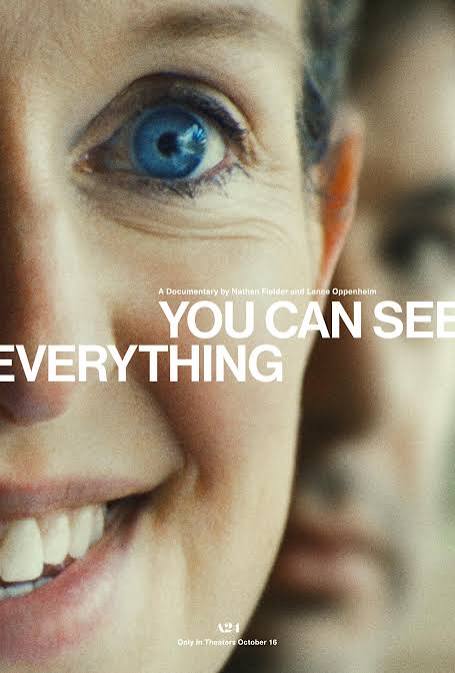
You Can See Everything, the A24 documentary from Nathan Fielder (Nathan for You, The Rehearsal) and Lance Oppenheim, follows Theranos founder Elizabeth Holmes through her last 34 days before reporting to federal prison in May 2023, filmed at home with her partner, hotel heir Billy Evans, and their two children. Fielder isn’t trying to relitigate her case. He wants to understand who Holmes really is, and when that proves elusive, he and Oppenheim make that difficulty the film’s central theme. By his own account, he ended with less certainty about her than when he began. The result is uncomfortable to watch, revealing both the hubris and the humanity of Holmes in her final days of freedom. Rather than draw conclusions about her inner life, the filmmakers leave viewers to sit with their own questions and decide for themselves. Many arrive with firm opinions of who Holmes is and leave with lingering questions about what is actually true: her motives, her integrity, and the influence of her intimate relationships.
Why I Am Writing About It
I’m writing about this film because so many friends and clients have asked for my take on it. They know my unique background: I hold a doctorate in clinical psychology, have practiced and taught psychological assessment in the past, and now work as an executive coach to tech founders and organizational leaders. My coaching work across the tech ecosystem has given me a close view of how brilliance, ambition, and blind spots coexist in the people who build and run companies.
I am also fascinated by how filmmakers use clinical ideas, knowingly or not. Fielder’s interviewing borrows from the logic of the assessment room: he probes her overly favorable self-presentation, examines the gap between Holmes’s scientific intelligence, social judgment, and verbal understanding, and explores her reliance on the men she trusts. Because the film brings attention to material that might lead people to draw hard conclusions about Holmes, this article aims to explain scientific concepts that underlie some of the questions being explored, specifically through the MMPI’s L scale, uneven cognitive abilities, folie à deux, and Dependent Personality Disorder.
Running through all of these concepts is a theme I return to constantly in my coaching work: self-awareness. In clinical language, it is often referred to as insight, the capacity to see ourselves accurately, including how we come across to others. Each section that follows touches a different facet of it.
The Boston Globe invited three psychologists to watch it. TODAY asked a clinical psychologist who studies facial cues why Holmes is so hard to read, and NPR’s Short Wave used the film to explore what behavior can and can’t reveal about deception. Critics are circling the same questions: The Ringer has written about the film’s “contagious delusion” and Holmes’s utmost conviction, and Resident called her a founder who may not believe she failed. What I hope to add is a closer look at the clinical concepts the film brings to mind.
To be clear: None of the diagnoses discussed here are my professional opinion of Elizabeth Holmes, Billy Evans, or Sunny Balwani. Psychologists and others with psychological training are held to a professional standard of not offering diagnostic opinions about people they have not personally evaluated (often called the Goldwater Rule), and a documentary is an edited work whose subject knew the cameras were rolling. These diagnoses are worth understanding because the film invites questions about them, and my aim is to clarify the difference between what a film might suggest and what a diagnosis requires.
“I Have Never Told a Lie”: The L Scale and Faking Good
Holmes tells Fielder she cannot recall ever telling a lie, not even a white lie, and speculates that if she ever did, it might have been in childhood. In psychological assessments, the L (Lie) scale of the Minnesota Multiphasic Personality Inventory (MMPI-2) is designed to examine a person’s relationship with honesty. One of the most widely used and researched personality assessments in psychology, the MMPI helps clinicians identify psychological conditions and personality patterns in clinical, forensic, and occupational settings, from treatment planning to court evaluations to screening candidates for high-stakes jobs.
What it measures. The L scale’s 15 items describe small, ordinary failings, like occasionally bending the truth or losing one’s temper, that almost everyone admits to. Denying many of them raises the score, suggesting an attempt to look unrealistically virtuous, or “faking good.”
Why it signals low psychological sophistication. The L scale catches a naive defensiveness. Its companion, the K scale, picks up subtler self-protection and tends to rise with education and psychological-mindedness. A sophisticated person who wants to look good knows that claiming perfection isn’t believable, so they admit to small flaws. An elevated L means the person didn’t make that calculation and has limited insight into how they come across.
Fielder lets Holmes’s claim stand, and given everything the public already knows about Theranos, it undermines itself. Viewers don’t conclude she’s honest; they wonder whether she knows how it sounds. That gap in insight is the clinical point. However, an elevated L score is not proof of lying. It can also rise in people with very traditional or religious upbringings, and in high-stakes settings where looking good matters tremendously. That describes Holmes’s situation: after years of legal scrutiny, she is weeks from prison, insisting that “you can see everything.”
Organizational psychologist Tasha Eurich offers a useful way to think about this. Her research distinguishes internal self-awareness from external self-awareness: how clearly we understand ourselves, versus how clearly we understand the way others see us. Surprisingly, the two are largely unrelated. A person can feel deeply certain of who they are while badly misjudging how they are perceived. The L scale, and much of what Fielder captures on camera, speaks to external self-awareness, and that is where Holmes seems to struggle most.
A Discrepant Cognitive Profile: Scientific Brilliance vs. Verbal Comprehension
Holmes’s intellect has long been central to her public story. Celebrated as the brilliant Stanford chemical engineering student who founded Theranos at 19 and dropped out to run it, she was hailed as the next Steve Jobs and named by Forbes the youngest self-made female billionaire. The film doesn’t dispute that reputation: Fielder makes clear she is fluent in scientific subjects he admits are far beyond him. He pairs that with a scene in which she cannot grasp Abbott and Costello’s classic comedy routine “Who’s on First?” even when he asks her to explain why it’s funny. The routine depends on names that double as questions, so getting it requires holding two meanings at once, drawing on cognitive flexibility, pragmatic language comprehension, and theory of mind.
In cognitive assessment, tests like the Wechsler Adult Intelligence Scale (WAIS) measure verbal comprehension separately from other reasoning abilities, and it is not unusual to see large discrepancies between them, such as superior technical reasoning alongside weaker verbal and social judgment. Because people tend to read strength in one area as competence in all of them, those discrepancies might go unnoticed by the investors and boards evaluating a founder. In assessment, the question becomes: does this person have the capacity to fulfill their own expectations, or do they tend to overestimate their abilities? Fielder seems to suggest that Holmes struggles to decipher verbal and social nuance as quickly or readily as one would expect from someone of her intelligence. That gap shows up both in the comedy routine and in her failure to anticipate how a far-fetched claim of absolute honesty will land. Is Fielder asking viewers to connect this reduced comprehension to her downfall? But one edited scene is an illustration, not a measurement, and no firm conclusions should be drawn about Holmes’s cognitive abilities. She is also likely sleep-deprived from nursing a newborn while caring for a toddler, and emotionally exhausted by her impending imprisonment, all of which could easily reduce her ability to catch on to the skit’s humor.
Folie à Deux: “Madness for Two”
Folie à deux (“madness for two”) is a rare syndrome, formally shared psychotic disorder, in which delusional beliefs pass from one person to another within a close, often socially isolated relationship. Typically a dominant primary person holds the belief and a more dependent secondary person adopts it; when the two are separated, the secondary’s beliefs often fade. The DSM-5 no longer lists it separately, classifying such cases under Other Specified Schizophrenia Spectrum and Other Psychotic Disorder.
Nothing in the film suggests the broader picture of psychosis, such as hallucinations or disorganized thinking. But Fielder repeatedly shows the relational structure the syndrome describes:
- Speed and intensity: both describe a bond that became all-encompassing almost immediately, with few if any boundaries and seemingly unlimited trust.
- A closed loop: a shared story of being grossly misunderstood and a mutual desire to change how others see her, reinforced by each partner and closed to outside challenge.
- Merged identities: Holmes granted Evans power of attorney before entering prison, and the film shows him posting as her on X. Fielder and Seyfried both voice concern about how much of Holmes’s public voice and image now runs through him.
- A shared grand plan: the film shows both planning a “Theranos 2.0,” an even more ambitious health biotech company. (Evans’s diagnostics startup, Haemanthus, has publicly said Holmes has no role in it.)
Evans’s own words reinforce this closed loop. Asked whether Holmes is good at protecting herself, he admits she is not. Asked whether he has ever suspected her of lying, he answers, “No. Never.” When Fielder asks what it is like when they argue, Evans says they never fight, acknowledging this might be hard to believe. Together, these absolute claims echo the L-scale pattern, applied to a couple. Healthy couples do argue; John Gottman’s research shows that what predicts a lasting relationship is how partners repair after conflict, not whether it happens. A report of no conflict usually signals avoidance, one partner routinely giving in, or a relationship so idealized that conflict can’t be acknowledged.
Underneath all of this is Holmes’s own conviction. Throughout the film, she makes clear that she still believes the Theranos technology worked, despite the outcome of her case. Clinically, a delusion is a fixed belief that persists despite clear contrary evidence, and her certainty, as depicted in the film, has that quality. A delusion can exist without a broader psychotic illness, as in delusional disorder, where people otherwise function well. Delusional thinking can also be associated with a personality disorder, in the form of rigid, grandiose, or self-protective beliefs. There are non-clinical explanations, too: denial, motivated reasoning in someone whose identity was built on a once-heralded invention, or the limits of self-awareness that make it hard to see what is obvious to others. Whatever its source, that shared belief appears to underpin the couple’s discussions of a new venture.
The film leaves open who the inducer is: Holmes, with Evans as devoted carrier, or Evans, in whom she has placed so much trust while incarcerated. The lens is useful because it makes the relationship, not either person, the unit of analysis.
Dependent Personality Disorder: Patterns in Her Partnerships
Dependent Personality Disorder (DPD) is a pervasive, excessive need to be taken care of, leading to submissive, clinging behavior and fear of separation, beginning by early adulthood. The DSM-5-TR requires at least five of eight features: difficulty making everyday decisions without excessive reassurance; needing others to take responsibility for major areas of life; difficulty expressing disagreement; difficulty starting projects independently; going to excessive lengths for nurturance; discomfort when alone; urgently seeking a new relationship when one ends; and preoccupation with fears of being left to fend for oneself. Diagnosis requires a clinical interview, history, and a pattern that is stable over time rather than explained by circumstances such as incarceration.
Several patterns in the film may resemble DPD features:
- Handing over major life domains. Balwani once ran Theranos operations alongside her. In the film, Fielder and actress Amanda Seyfried (who played Holmes in The Dropout) both express concern about how much trust and control Holmes has given Evans while she is incarcerated. When Fielder presses her on Evans’s deals, including his later-dropped bid for a share of the documentary’s profits, she answers that money is “not my thing.” That stance lets her hand off financial responsibility without examining it, and, like never lying and never fighting, it denies a motive nearly everyone has.
- Moving from one dominant partner to the next. The film traces a series of close relationships with men Holmes has trusted almost completely: first her father, who in the film expresses paternal pride and protection; then Balwani, who looked past a nearly 20-year age gap to partner with her both romantically and professionally; and now Evans. Each of these men, moved by her for his own reasons, goes to great lengths to protect her. This is a common pattern in dependency: reliance on others tends to draw caretaking out of the people around them.
- Not disagreeing. At her 2021 trial, she testified that she deferred to Balwani, and that he had been controlling and abusive, which he denied. Evans’s “we don’t fight” may reflect the same pattern, but it is his description of the couple, not hers.
- Poor self-protection. Evans’s admission that she isn’t good at protecting herself fits the DPD tendency to give up self-advocacy to keep a relationship secure. It echoes her defense at trial, which argued that she relied on Balwani for lab operations and finances. Whatever the jury concluded, her own account is a story of handing responsibility to a trusted partner and not protecting herself from the outcome.
The strongest counterevidence is her career. Founding a company at 19 and running it as CEO for over a decade is hard to square with difficulty starting projects independently. A more cautious description is dependent traits within romantic relationships: a fiercely independent public self paired with a highly reliant private one, a common pattern that is not the same as a personality disorder.
The Pull to Protect: Fielder, Seyfried, and Holmes
One of the film’s most interesting threads is how the people trying to understand Holmes keep being pulled toward her. At times, the film brings Fielder into excruciating closeness with Holmes: he is present as she, Evans, and their newborn share caresses, he makes a point to ask them if he is interfering with their final opportunity for sex before her imprisonment, and he goes to great lengths to protect her from being kept in the dark about decisions Evans makes on her behalf while she is in prison. Holmes invites this closeness, too, urging him to test his discomfort with cold water by sharing one of her favorite sensory experiences: the expansive, bracing freedom of swimming in the open sea. He hesitates at first, but later reveals that he took her up on it, and the two appear joyful and connected in the water despite his stated reluctance. Throughout the film, he seems unsure how to understand his connection to her, and he goes through a romantic breakup of his own during filming.
Seyfried gently asks Fielder whether he is struggling with an urge to protect Holmes, and whether his feelings might interfere with how he tells her story. He immediately denies he’d let his feelings obstruct the truth, but viewers are left wondering what to make of his real feelings about her. Seyfried herself is sympathetic to the idea that Holmes has been exploited by the men in her life, yet steadfast in her desire to give an honest depiction of Holmes, while acknowledging that any actor’s portrayal inevitably assigns some intent. Both Fielder and Seyfried seem to want to protect Holmes from Evans, and in doing so, they implicitly assume she is unable or unwilling to protect herself.
In clinical work, there is a name for this: countertransference, the feelings a client, or in this case, a cinematic subject, stirs up in the person trying to understand them. Clinicians are trained to notice these feelings because, left unexamined, they can skew what we see and how we respond. Fielder’s and Seyfried’s vacillation, from skepticism to closeness and back again, is part of what makes the film feel so honest. It also echoes a pattern discussed above: Holmes seems to draw protectiveness from nearly everyone who gets close to her.
What the Film Leaves Us With
Fielder offers no tidy conclusion, and I think that’s the point. He shows a woman with brilliant technical reasoning who seems at times to struggle with nuance most of us take for granted, and who has repeatedly placed full trust in the people closest to her. But You Can See Everything also shows an emotional postpartum mother facing separation from her two young children, and a person whose blind spots may have left her far more exposed than she realized. None of this erases her accountability. It does make her more recognizable as someone whose fall from grace is painfully human.
What can we learn from it? First, that intelligence and self-awareness are different capacities. Brilliance in one domain can coexist with real difficulty seeing how we come across and judging the true limits of our own capacities, and the people around a gifted founder, from investors to boards, can easily mistake one for the other. Holmes’s story is a cautionary tale: even the most brilliant creators cannot be assumed to exercise clear judgment when their self-awareness is limited. Second, that trust without boundaries carries risk, both for the person who extends it and for those who feel drawn to protect them. And third, as Eurich’s research suggests, experience and power tend to erode self-awareness, which is why it can be hardest to maintain for the very founders who have achieved the most. In my work with founders, I see versions of this tension often: real gifts alongside real blind spots, and a deep need to trust others during life’s hardest moments.
For investors, boards, and anyone else with skin in the game, the practical lesson is to seek better information about the people entrusted with decision-making power, ideally gathered with the leader’s consent by independent, third-party evaluators:
- Use multi-rater (360-degree) assessment. Comparing a leader’s self-ratings with how colleagues, direct reports, mentors, and board members rate them reveals whether the leader’s self-view is accurate. Leadership research has found that “overestimators,” who rate themselves well above how others see them, tend to fare worse than leaders whose self-assessments match others’ views.
- Protect the integrity of the process. As an executive coach, I have conducted hundreds of 360-degree assessments, and I can attest both to their value and to the challenge of maintaining their integrity. Rater confidentiality is difficult to guarantee, especially on small teams and boards, and raters who fear retribution or worry about being singled out as a circumstantial outlier may soften their ratings. This is where independent, third-party administration matters most.
- Include validated personality and derailer measures. Tools such as the Hogan Development Survey identify traits like overconfidence and an inflated sense of competence that can fuel early success before becoming liabilities.
- Verify claims independently. A founder’s confidence is not evidence. Technical and scientific claims should be reviewed by qualified outside experts with no stake in the outcome.
- Reassess over time. Because experience and power tend to erode self-awareness, a single evaluation at the start is not enough; the most successful leaders still need regular, honest feedback.
And that may be the film’s final irony. For a documentary titled You Can See Everything, what a closer look ultimately reveals is how much we cannot see. The psychological testing, history, and clinical context needed to truly understand how Holmes functions are simply not available to us. What we see on screen invites questions; it cannot answer them. If there’s one takeaway I can leave you with, it’s this: we can never see everything. The danger lies in believing, and acting as though, we can. Hope for the best, but work to create a future that safeguards against the worst.
Sources and further reading: A24; American Psychiatric Association, DSM-5-TR; Butcher et al., MMPI-2 Manual; Lasègue & Falret (1877); Boston Globe, “We invited three psychologists to watch ‘You Can See Everything'”; TODAY, “I’m a therapist trained to read facial cues”; The Ringer, “The Contagious Delusion of ‘You Can See Everything'”; The Ringer, “The Utmost Conviction of Elizabeth Holmes”; Resident, “Elizabeth Holmes: The Woman Who Refuses to Believe She Failed”; Katie Couric Media, “Elizabeth Holmes Has One More Thing To Sell: Herself”; NBC, “Elizabeth Holmes’ partner, Billy Evans, speaks out following the release of ‘You Can See Everything'”; TheWrap, “Amanda Seyfried Says She Became a ‘Billy Detective'”; IndieWire, “Amanda Seyfried Is Still No Closer to Who Elizabeth Holmes Really Is”; Chamorro-Premuzic, “Could Your Personality Derail Your Career?” Harvard Business Review; Hogan Assessments, Bold scale; Fleenor et al. (2010), “Self-Other Rating Agreement in Leadership: A Review,” The Leadership Quarterly; Eurich, “What Self-Awareness Really Is (and How to Cultivate It),” Harvard Business Review; The Gottman Institute; StatPearls, “Shared Psychotic Disorder”; PubMed, review of Dependent Personality Disorder; American Journal of Psychotherapy, on countertransference; American Psychiatric Association, “The Goldwater Rule”; Britannica, “Elizabeth Holmes”; NPR, “Elizabeth Holmes Testifies About Alleged Sexual and Emotional Abuse at Fraud Trial”; Industrial and Organizational Psychology, “Performance Appraisal: Feedback”; NPR, Short Wave; and reporting from the Associated Press, NPR, Variety, Inverse, Fortune, The Daily Beast, and Law Commentary.


You must be logged in to post a comment.